Sunday, 23 March 2014

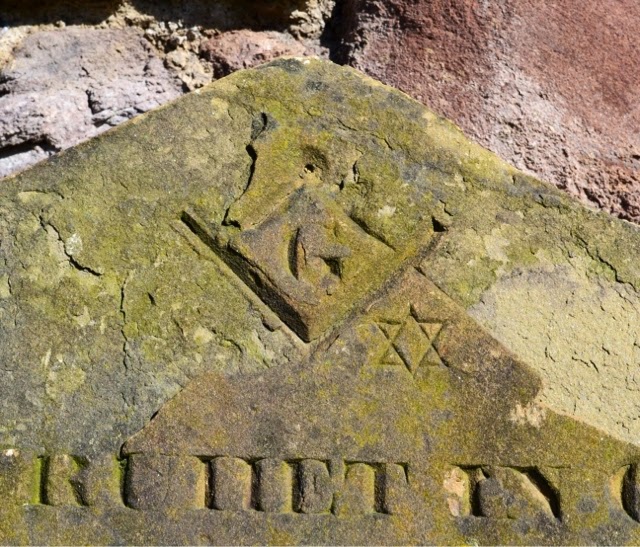
Headstones at St. Peter's Church, Sunderland


Local records; or, Historical register of remarkable events which have occurred in Northumberland and Durham, Newcastle-upon-Tyne, and Berwick-upon-Tweed, commencing with the year 1833 to the end of 1866

1839, June 13

The body of a man was found in the river Wear, at Sunderland, attached by a rope to a large stone. the skull was fractured into numberless pieces; and the body was naked, save a flannel shirt and stockings.

The body was removed to the workhouse at Monkwearmouth, where it was identified by two of the crew of the Phoenix, of Stettin, as that of their captain, Johann Friedrich Berckholtz, who was about 55 years of age.

No doubt being held as to the deceased having met his death unfairly, instant search was made, and the cabin was found to bear evident marks of the deed. Subsequent investigation led to the committal of Jacob Friedrich Ehlert, the mate of the ship, and Daniel Muller, aged 19, the cabin boy, and they both confessed being accomplices in the murder, but mutually charged each other with the deed.

From the statement of the boy, who was admitted a witness to the crown, it appeared that on the night of the 11th, the mate, after giving him some spirits, induced him to go into the cabin where captain slept, and while he (the boy) held a lantern, the mate struck the unfortunate master three heavy blows on the head with a hammer, by which death was caused immediately.

They then got into a boat and rowed near to the bridge, dragging theory body after them, and the mate having produced a stone, he tied it to the body, and let both sink into the middle of the stream.

There were several circumstances in the boy's story corroborated by the crew and others concerned in the matter.

The jury found Ehlert guity, and he was executed at Durham on the 16th August, persisting in his innocence to the last. He was native of Barth-Pomerania.


Sunday, 16 March 2014

St. Paul's Church, Jarrow

It is probably the most historically famous English church.

In order to honour the union of the Celtic Druid Church and the Roman Church, in the year 674, King Ecgfrid (Alchfrid), son of King Osuiu (Oswin) had given a gift to this new Brotherhood of seventy “hides or families” of land (60-120 acres) at the mouth of the River Wear on which to build the monastery.

This is when the Anglo-Saxon brotherhood had established the first monastery of the blessed St. Peter, the chief of the apostles to be built after he was declared rock of the Catholic Church in 666.

Shortly thereafter in 681, a sister monastery would be added and dedicated to the blessed St. Paul.

St. Bede tells us “that mutual peace and concord, mutual and perpetual affection and kindness, should be continued between the two places; so that, (for the sake of illustration,) just as the body may not be severed from the head by which it breathes, nor may the head forget the body, without which it has no life,—in like manner no one should attempt in any way to disturb the union between these two monasteries.” And St. Ceolfrid had said this of the occasion, “St. Benedict Biscop completed and ruled the monastery of St. Paul’s seven years and afterwards ably governed…….the single monastery of St. Peter and Paul in its two separate localities.”

In order to properly build churches that would last the test of time and also to lavishly decorate these buildings, Biscop had travelled to Gaul (modern day France) in order to hire stone masons and window glaziers. These craftsman were said to be Merovingian.

They were known for their opus gallicum (Latin for “Gallic work”). This was a technique where precise holes were created in stone masonry for the insertion of wooden infrastructure. These building techniques were used  extensively in church architecture. Both Bede and Biscop were actually the Irish and English kin of these Merovingians from France.

Sunday, 2 February 2014

Church of Our Lady, Seaton Delaval Hall

900-year-old Church of Our Lady, tucked away behind Seaton Delaval Hall on the A190, has several features which make it a rarity, perhaps unique:
  • Despite its age (it was built by Hubert de Laval and dedicated in 1102 by Bishop Flambard, of Durham), it has only been a parish church since 1891. Before that it was a private chapel for nearly 800 years.
  • Its chancel, choir and nave are separated by superb Norman arches and to have two in a building of this size is very unusual.
  • A blocked up window and stonework in the north wall of the nave and the top section of the font suggest pre-Norman origins but the nave also has a classical 18th century ceiling. So we have an Anglo-Saxon/Norman church with a Georgian ceiling!
  • The church is one of very few in the Church of England dedicated solely to Our Lady – indeed it may be the only one.

Other features include 13th century effigies of a knight and a lady, eight cusped panels from about the same period containing shields bearing Delaval and other arms, a piscina bowl with credence shelf above possibly from the 14th century, six hatchments of the Delaval and Astley families, and the tracery from a 14th century window at the east end (the window was replaced in 1861 and the old tracery, carved out of one piece of stone, was placed against the south wall outside the church until it was built into the wall above the door of the entrance porch, constructed in 1895).


The stained glass in the windows is all Victorian. The window in the east end wall is believed to be by William Wailes, of Newcastle, and most of the others are by his successors, Wailes and Strang. The one exception is in the south wall of the choir. The Prince of Wales window, possibly by Thomas Willement, was bought in 1841 by Sir Jacob Astley, later Lord Hastings, and came from the Colosseum in Regents Park, London. It was thought at that time to depict the Black Prince and it was not until the late 1990s that it was discovered that it in fact shows Prince Arthur, eldest son of Henry VII and brother of Henry VIII. It is a copy of a light in the Magnificat Window, in Great Malvern Priory.
 
Robert Delaval was baptised in the church on June 22, 1263, and Henry Delaval on January 12, 1343.
 
Mystery surrounds the identities of a knight and his lady, whose chest tombs were placed in the church in the 13th Century. They could be either Sir Eustace Delaval, who died in 1258 and his wife Constance de Baliol, or Sir Henry Delaval, who died in 1271, and his wife Mary de Biddleston.

For 400 years the Delavals were buried in the church crypt, with the last internment in 1796. At the end of the 19th Century the crypt was opened and a record made of the six coffins which could be identified. Plates from two of the caskets are mounted on the church walls.

Among the occupants of the vault, now bricked up, are Sir Frances Delaval and Admiral George Delaval, the builder of Seaton Delaval Hall, who died near the house after falling from his horse.
The base of an obelisk marks the spot.

But the puzzle concerns the corpse of a man in the crypt who is not a Delaval. Sir Alexander Ruthven was buried in the vault in 1722.

Also in the crypt is Lord John Delaval's mistress Elizabeth Hicks, who was 16 when the relationship began and who died in her 20s in 1796.

Hubert de la Val went on the First Crusade and helped his uncle Robert of Normandy rescue the Holy Sepulchre from the heathen.

Friday, 24 January 2014

Beverley

Beverley is a market town, civil parish and the county town of the East Riding of Yorkshire.

Beverley Preceptory, Knights Hospitaller

founded c.1201, manor of the Holy Trinity and other endowments granted by Sybilla de Valoniis;
dissolved 1540; granted to William Berkeley 1544/5

A preceptory was established at Beverley at the beginning of the 13th century, probably in 1201, when Sybil de Beverley, second wife of the third Lord Percy, gave to the Knights Hospitallers the manor of Holy Trinity, east of Beverley, the manor of North Burton and other lands.  In 1338, besides their house and grounds at Beverley, the knights had some 350 acres at Burton, 150 acres at Fitling, 120 at Walsay, 270 at Cleving, and about the same at Dalton. The voluntary offerings collected in the district were reckoned at £20, the whole issues being rather over 125 marks. From this had to be deducted various expenses for the exercise of hospitality, as enjoined by the founders, and for the support of the establishment, consisting of a preceptor, Simon Fauconer, knight, and two brethren, Simon Belcher, knight, and Philip Ewyas, sergeant, two chaplains and clerks employed to collect the voluntary offerings, a steward and the usual retinue of servants. The clear yearly profits amounted to 60 marks. The estates of the Templars' preceptory of Westerdale were at a later date put under the commander, or preceptor of Beverley, and the total value of the preceptory of Beverley was returned in 1535 as £164 9s. 10d. John Sutton was preceptor at this time, as he had been in 1528, and continued to hold the post until the suppression of the order in 1540, when he was given a pension of £200.

The Church of St. Mary, Beverley, is supposed to have had upon its site, a Chapel of Ease dedicated to St. Martin by Archbishop Thurston, of York, between 1114-42; it is certain, however, that it was constituted a Vicarage of St. Mary in 1325. The Nave was built about 1450, and consists of six bays and seven clerestory windows, but in 1530 the upper part of the central tower fell upon the Nave with
much loss of life. Its pillar was erected by the Guild of Minstrels, which like that of the Masons, claimed to date from Saxon times; it has upon the fluted cornishes five figures of the Minstrels with their instruments, of which only two respectively with guitar and pipe are intact; and stands on the north side facing the pulpit. The "Misere" stalls in the chancel are of the 15th century, with carved bas reliefs under the seats; one of these represents a "fox" shot through the body with a woodman's arrow, and a "monkey" approaching with a bottle of physic.

Around 1450 the will of a mason from Beverley gives a tantalising glimpse into the emergence of masonic regalia. An inventory of John Cadeby's possessions mentions several zonas, or girdles. Two were silver mounted, and one of these had the letters B and I in the middle, indicating Boaz and Jachin, the twin pillars of Solomon's Temple.

Thursday, 2 January 2014

The Templars are everywhere

The arrest of the Templars in 1307, the suppression of the order in 1312 and the execution of Jacques the Molay in 1314 saw the end of the order in the eyes of academic historians. Nevertheless, the order did not cease to exist. Given the number of knights who escaped, who remained at large or who were acquitted, it would be surprising if it had.

Although King Philip's seizure and destruction of Jacques the Molay and the French Templars was quite efficient, there is no record of hid finding the Templar treasure in Paris of the secret archives of the order or its fleet, based mainly at La Rochelle in Brittany. Much evidence and some tradition points to the removal of the treasure and most of the archives on ships, with refugee Templars taking these to Portugal and to the west and east coasts of Scotland, where they were welcomed.

There is documented history for the Templars in Scotland. Following the foundation of the order in c.1119, Hugh de Payens came to England in 1128. King David of Scotland invited him to come north of the border and probably gave him land at Balantrodoch, to the south of Edinburgh. This is now known as Temple, and is where one of the order's two Scottish preceptories was founded, the other being Maryculter on the River Dee to the south-west of Aberdeen. The order also had posessions in Lothian, Falkirk and Glasgow.

Only two Templars were arrested in Scotland, Walter Clifton and William Middleton, a native of Northumberland, born near Newcastle.

In Portugal, the Templars took the name of the Knights of Christ. Columbus's father-in-law was a member of this order and it was with nautical charts inherited from this relative that Columbus undertook his voyage of discovery.

Wednesday, 1 January 2014

Who and when?

The date of the story is of course uncertain, but nine ascending generations from the late General Lambton, in whom popular tradition affirmed the curse to expire, would exactly reach to Sir John Lambton, Knight of Rhodes, of whom this curious entry stands in an old MS pedigree, lately in possession of the family of Middleton of Offerton:

'Johan Lambeton that slewe ye Worme was Knight of Rhoodes and Lord of Lambeton and Wod Apilton efter the dethe of fower brothers sans esshewe masle'.

That the knight ever succeeded to the family estates however contradicts the proven pedigree.

"The history of the holy, military, sovereign Order of St. John of Jerusalem; or, Knights Hospitallers, Knights Templars, Knights of Rhoades, Knights of Malta"  :

Sir William d'Aunay the Turcopolier, and Sir John Lambton, are selected as of the most renowned
knightfif of the English language in 1454.


Ancient and Modern Malta: Containing a Description of the Ports..., Vol. 3, by Pierre Marie Louis de Boisgelin de Kerdu, Priors and Grand Priors of England, Sovereign Order of St. John of Jerusalem and of Rhodes:

Sir William d'Aunay the Turcopolier in the year 1453

Hospitaller Sources, calendar for 1450:

23 December, 1450
The Master Fr Jean de Lastic and the Convent to Fr John Langstrother preceptor and receiver in the priory of England: inform him that Fr John Lambeton has rendered account in front of the administrators of the Treasury about his preceptory Beverley and his expenditures as lieutenant turcopolier and for the English brethren in the Convent; from this it follows that they owe him 107 fl. 11 asp. 14 d. Rhodesian currency; Fr Langstrother shall pay him from the first incomes from mortuaria and vancantiae in England without using the responsions.

Ancient and honourable family of Lambton

John de Lamtun was witness to the charter of Uchtred de Wodeshend between 1180 and 1200.

Robert de Lambton, Lord of Lambton son and heir of William son of Robert, occurs in an inquisition in 1350, then aged 24 years. His son, William de Lambton, married Alice daughter of Salcock of Salcock, Lancaster. He was succeeded by his son, William de Lambton.

William de Lambton was born on 1 Jan 1390 in Lambton, Durham, England, son of William de Lambton and Alice Salcock. He married Elizabeth about 1405 in Lambton, and died before 1432/1433.

The Church of Chester-le-Street - on a brass plate in the Lambton pew, in the South aile, now removed:
Orate pro animabus Wiltimi Lambton, arm. qui obiit 20 July 1430, et Alicie uxoris ejus quæ obiit 143., quor. animabus propitietur Deus.
(Pray for the souls of Wiltimi Lambton, arm. who died 20 July 1430, and Alice, his wife who died the 143., whose. for merciful God.)
Arms, Lambton, impaling, Argent, three dunghill-cocks Gules, Salcock

William and Elizabeth had the following children:
Robert Lambton- born in 1406 in Lambton, Durham, England. Married Joanna. He died after 11 Mar 1442 in London, Middlesex, England, and was buried in Church Of The Friars Carmelites, London. Will dated 11 March 1442, proved 1443.

Thomas Lambton-1408

William Lambton-born about 1410 in Lambton, Durham, England. Named in his mother’s will 1439 and that of his brother Thomas 1442, Master of University College Oxford 1461.

John Lambton- born about 1412 in Lambton, Durham, England. Named in his mother’s will 1349 and his brother in 1442, then Knight of Rhodes.

Alice Lambton-born about 1414 in Lambton, Durham, England. Mentioned in her mother’s will in 1439.

 Elizabeth Lambton- born about 1416 in Lambton, Durham, England.
             
In the 1500s, a John Lambton married Agnes Lumley, of Ludworth, forming a link between the Lumleys and Lambtons, and this also added some royal blood to the Lambton line because Agnes was a great-granddaughter of King Edward IV.

The Lambtons were a family of good and valorous repute long before the date of their family legend, which only ascends to the fourteenth century and it does not appear that the hero of the tale reaped any thing from his adventure, except the honour of the achievement and a very singular curse on his descendants to the ninth generation.

Popular tradition assigns the chapel of Brugeford as the spot where Lambton offered up his vows before and after the adventure (this foundation however it has been shown existed at a period antecedent to the earliest date assigned to the legend).

In the garden house at Lambton are two figures of no great antiquity. A knight in good style armed cap-a-pee, the back studded with razor blades, who holds the Worm by one ear with his left hand, and with his right crams his sword to the hilt down his throat, and a lady who wears a coronet with bare breasts &c in the style of Charles II Beauties, a wound on whose bosom, and an accidental mutilation of the hand, are said to have been the work of the Worm. A real good Andrea Ferrara, inscribed on the blade 152,1 notwithstanding the date, has been also pressed into the service and is said to be the identical weapon by which the Worm perished .